The future (of Services) is digital: HealthHub
Performance & Operations
The future (of Services) is digital: HealthHub
Rail is going digital and Alstom is leading the way.
At the heart of this transformation in Services is HealthHub™, our industry-leading, in-house platform that turns real-time railway data into actionable insights.
Implemented in over 100 projects, HealthHub is helping operators predict issues before they occur, to keep trains running smoothly and deliver superior passenger experience.

Crystal-ball maintenance powered by big data
A train in service fires off hundreds of real-time messages on speed, energy consumption, GPS location, carriage temperature and more. To make this vast amount of data both accessible and useful - this need gave birth to our innovation.
HealthHub is our cloud-based, digital solution that continuously tracks the health of railway systems - including rolling stock, tracks, catenary and signalling.
HealthHub corrals this flow of information, applies algorithms designed by Alstom data scientists and shapes meaningful results that materialise in an intuitive interface.

“The ambition is simple: no interruptions in service. Maintenance should never happen during service hours.”
Lena Nicolas-Kryzhko
Alstom Digital Solutions Commercial & Business Development Director
Operators can then trigger precise maintenance at the most advantageous time: during off hours, when passengers and timetables won’t be affected.
In a larger sense, HealthHub drives predictive maintenance and data-driven decision-making, reducing downtime, optimising maintenance schedules and ultimately improving service quality.

-
+100projects across 5 continents
-
+60Alstom experts dedicated to development, deployment and support
-
30%up to 30% reduction in downtime
Beyond availability
HealthHub also drives condition-based maintenance that reduces waste. For example, HVAC filters, once replaced every three months, are now changed every six to seven months thanks to differential-pressure monitoring - halving annual material use while streamlining planning.
Over time, HealthHub has evolved into a strategic solution for our customers. Part of this strategy is a promise to make sure all Alstom trains are CBM (condition-based maintenance) ready when leaving the factory.
In addition, it integrates with other systems such as the Maintenance Management System (MMS), automatically converting alerts into traceable work orders. This scalability and adaptability make it a powerful tool for supporting the digital and services strategy.
Going further, HealthHub isn’t limited to Alstom employees. Our customers can access the platform as part of larger service contracts. “These service offerings create full transparency and more intimate customer relationships,” Nicolas-Kryzhko explains.

In action: the Réseau express métropolitain (Montreal)
On the Réseau express métropolitain (REM) in Montreal - one of Alstom’s largest service contracts - HealthHub ensures reliability on a network that will ultimately stretch 67 km. It’s the most advanced automated rail system currently in commercial service in the world.
“We run about 20 hours a day and have only a three-hour window at night - digital tools are how we make maintenance happen on time,” explains Frédéric Sanchez, Director of REM Special Maintenance Projects.
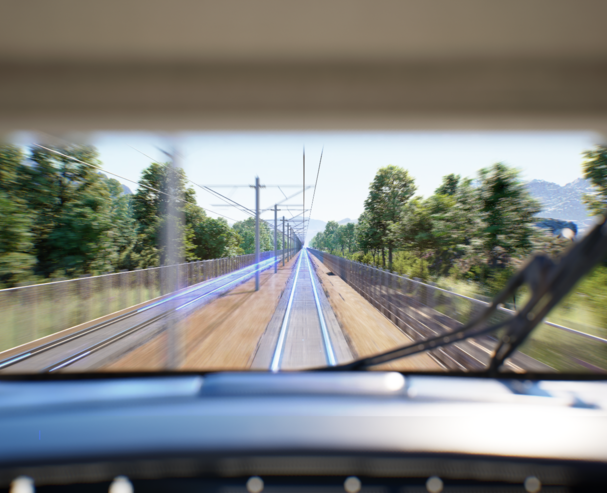
As part of a €10 million (CAD 16 million) investment, HealthHub brings together data and insights from several complementary modules to make off-hours repairs possible. Onboard measurement systems continuously record track and catenary geometry during passenger service, effectively turning commercial trains into rolling inspection vehicles.


At the depot, TrainScanner™ - think of a giant MRI machine of lasers and cameras - captures high-resolution imagery of each train as it passes through, measuring pantograph carbon and wheel diameters while detecting issues such as missing screws or impacts.
Meanwhile, on an automated line with no driver to sense irregularities, HealthHub monitors the current of door motors at every station stop. “So far, 100% of door alerts we investigated corresponded to a real issue,” notes Sanchez.
Uninterrupted service and greater cost efficiency - HealthHub shows how we can exploit emerging digital technologies to position rail as the logical choice for tomorrow’s mobility.


.jpg?h=ddb1ad0c&itok=Pesc9oKs)

.jpg?h=8f74817f&itok=FIP97rwJ)